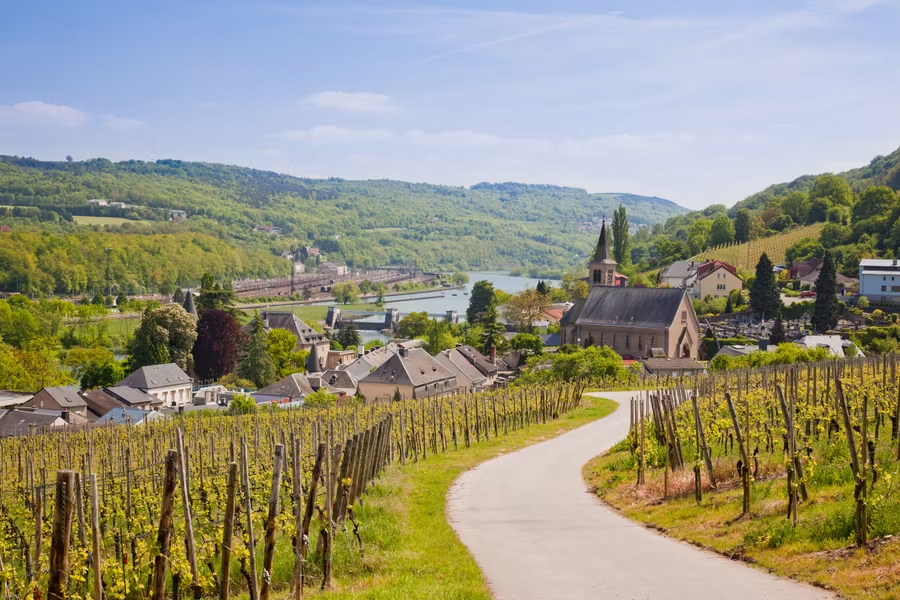
According to legend, Luxembourg was founded in 963 by Count Siegfried, a descendant of Charlemagne. The city was siezed in 1443 by Philip the Good, Duke of Burgundy. It was later integrated into the territory of the Netherlands and drawn with them into various battles and disputes. In 1684 it was conquered by Louis XIV, whose army was under the control of the Marquis of Vauban. Vauban redesigned the defences of the city, and made it into a formidable entity. It came back under the control of the Habsburgs in 1697. Luxembourg was then conquered, in 1795, by the French Revolutionary troops. In 1815, after the creation of the Grand Duchy of Luxembourg, which became a member of the German Confederation, the city was made a federal fortress with a Prussian garrison.
During the 19th century the conflict between the Bourbons and the Habsburgs had Luxembourg at the front line between France and Germany. War over it almost broke out between Napoleon III and Bismarck in 1867, avoided at the last moment by the Treaty of London: the Grand Duchy was declared a neutral state, and the fortifications of the Capital were dismantled…
Luxembourg was invaded by the Germans in May, 1940. The Americans started their liberation in September, 1944 but a German counter-attack in December of that year meant that fighting continued until May 1945…
The bus from Saarbrücken Hbf cost €5 and takes 1hr15 – a nice, easy way to get there. There’s a TGV from Paris Est that takes about 2hr12 and stops at Metz and Thionville on the way – they seem to be upgrading the line between Luxembourg and Thionville and that should shorten the journey time…The central station combines tram and bus stops along with trains. For getting around and planning routes, I used the CFL app, which is very easy to use. Public transport within Luxembourg is free… See: https://www.cfl.lu/en-gb
The Corniche:
The Corniche runs along the Alzette valley on the ramparts – built by the Spaniards and the French in the 17th century – from the Bock Promontory up to the lower part of the Holy Ghost Citadel, the so-called “Rondellen”. Until 1870 the Corniche had staircases in steep parts which were levelled off after the dismantling of the fortress. Most of the protecting wall was cleared away, leaving a superb panorama of the valley of the Alzette, the city district of Grund and the Rham Plateau…Looking down on the River Alzette and the Church of Saint John. The earliest mention of a church on this site is 1309 but the current church was built between 1688 to 1705.The spires of the Cathedral of Notre DameView from the train
The Cathedral:
The Cathedral of Notre Dame was founded in 1613, initially as a Jesuit church. It became a cathedral in 1870 and was enlarged between 1935-8
The City:
The Place Guillaume II, named after William II, King of the Netherlands and Grand Duke of Luxembourg…The Town Hall was built between 1830-8The State Savings Bank was created in 1856 and this imposing head office was built between 1910-13 and then extended in 1933…The Grand Ducal Palace and the Chamber of Deputies on the Rue du Marché-aux-Herbes – the palace is the official residence of the Grand Ducal familyThe terrific City Museum – slightly confusing layout over 5 floors but lots to see…The flight path into the airport – anyone wondering if there any 747s still flying…Free spiritsHeightened surveillance…
Side Streets:
Looking down Rue Sigefroi to St Michael’s Church – founded in 987, although the present church dates from 1688 and renovated in the 1980s – just behind me is Ënnert de Steiler – a nice friendly bar with outside seating… A glass of Bofferding at Ënnert de Steiler, albeit served in a Battin glass. Bofferding is brewed by Brasserie Nationale, which is still independent. Diekirch is owned by AB-InBev. There are some craft breweries, too, including Brasserie Simon and Twisted Cat…
Nightshades:
Echternach
Getting to the charming little town of Echternach is straightforward. Take the tram heading the direction of the airport; get off at Luxexpo, walk around the corner to the bus station there and get a bus – it’s not especially quick but it’s easy and free, of course…
The Churches:
The Basilica of St Willibrord – not a saint I’d heard of before, although there’s a St Willibrord’s Church in Manchester. Willibrord was born in Northumberland in 658. By 690, Willibrord was undertaking missionary work in Friesland and became Archbishop of Utrecht in 695 and died in 739…Willibrord founded the Benedictine monastery here in 698. The church was rebuilt between 1016-31. Following the French Revolution the church was left in ruins before being restored between 1862-80. It suffered further damage during WW2 and consecrated as a Basilica in 1953…The Lycée Classique (High School) is adjacent to the Basilica and explains why there are so many schoolkids wandering around – they tend to go around in groups, so wait for them to pass and quickly take your photo before the next wave comes along…The tomb of St Willibrord is in the crypt…A poignant memorial to the local Jewish population exterminated in WW2…The Church of St Peter and St Paul is signifcantly smaller than the mighty Basilica but it sits in a nice location on a little hill and the interior is a gem
The Marketplace:
Vianden
The Castle:
Vianden Castle was built and extended during the 11th to 14th centuries – it fell into ruins during the 19th century and subsequently restored in the late 20th century…Looking down on Vianden and the Our River from the castle…
The Town:
The River Our
Ettelbruck
There are frequent trains from Luxembourg Central Station to Ettelbruck. The little bus station is adjacent to the railway station in Ettelbruck, where you can get a bus to Vianden and, yes, it’s all free…
The Town:
Street Art:
In recent years, Ettelbruck has become a centre of street art in Luxembourg. A number of Luxembourg and international artists have created works on many of the town’s walls. Each of them is dedicated to a particular subject and conveys a message. During a “Street Art Tour”, organised by the Ettelbruck City Tourist Office in collaboration with Visit Éislek, participants can discover these creations…
Schengen
Located in the triangle where Luxembourg and the Benelux countries border Germany and France, Schengen caught the world’s attention in June 1985 when it hosted the historic signing of the “Schengen Agreement”, formalising the agreement between the original EU countries to abolish border controls between them.